
How Automated Conveying Systems Reduce Labor Costs by 40% in Mattress Manufacturing
In mattress manufacturing, labor cost is not driven only by how many workers are employed on the production line. It is driven by how often products are lifted, carried, repositioned, waited on, or corrected by human hands. These activities rarely add direct value, yet they consume a significant portion of total manpower.
As factories scale up, expand product ranges, and pursue 24-hour operation, traditional manual material handling becomes a structural limitation. This is why more mattress manufacturers are turning to automated conveying systems as a core infrastructure upgrade rather than a peripheral convenience.
This article explains, in practical and operational terms, how automated conveying systems help mattress factories reduce labor costs by approximately 40%, not by replacing workers indiscriminately, but by redesigning how work is organized, synchronized, and controlled.
For reference to related equipment and integrated automation concepts, you may consult the internal company page:
https://mattressmachineryzl.com/
Why Material Handling Dominates Labor Cost in Mattress Factories
In many mattress factories, the largest share of labor is not spent on sewing, gluing, or tape edging. It is spent on moving mattresses between processes.
Typical labor-intensive handling tasks include:
- Carrying semi-finished mattresses between machines
- Aligning products before processing
- Turning or rotating mattresses manually
- Waiting for upstream or downstream processes to finish
- Correcting misplacement or orientation errors
Each of these tasks may seem minor on its own. Together, they form a continuous drain on labor efficiency.
Automated conveying systems target exactly this hidden labor consumption.
What an Automated Conveying System Really Is
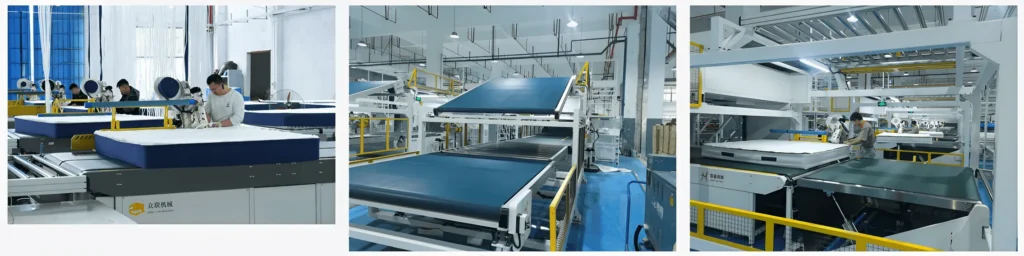
An automated conveying system is not simply a belt moving products from point A to point B. In a modern mattress factory, it is a process coordination system.
It typically includes:
- Roller or belt conveyors
- Directional transfer units
- Lifting, turning, or flipping modules
- Buffer and accumulation zones
- Centralized control logic
Its real value lies in how it connects machines into a continuous flow, eliminating manual intervention between processes.
Eliminating Manual Carrying and Lifting
Manual carrying is one of the most labor-intensive and injury-prone activities in mattress production.
When conveying is automated:
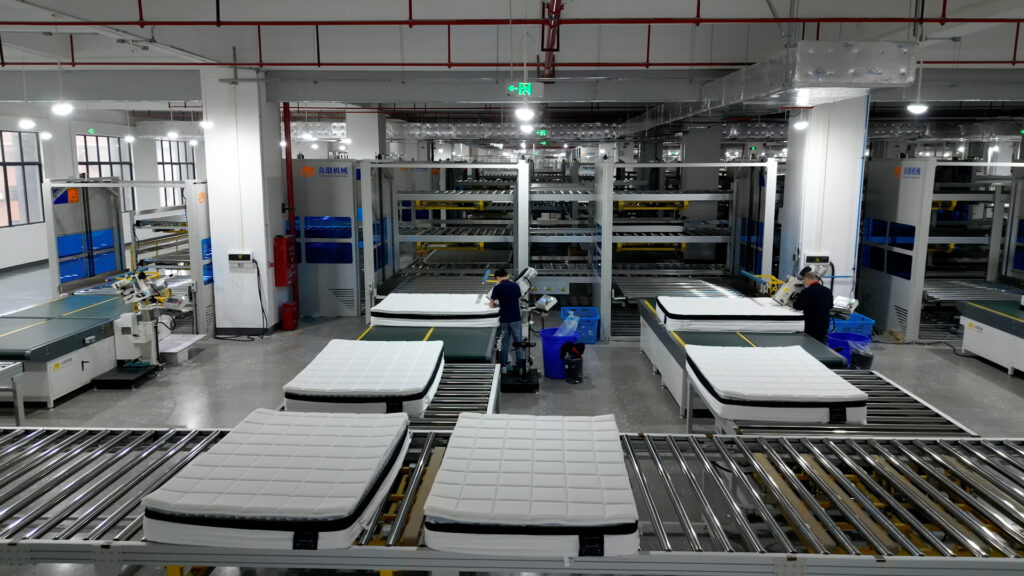
- Mattresses move automatically between stations
- No workers are assigned to physical transfer tasks
- Lifting, dragging, and repositioning are eliminated
In most factories, this alone reduces manpower requirements by 15–20%, while also lowering injury risk and fatigue-related inefficiency.
cURL Too many subrequests.
cURL Too many subrequests.
cURL Too many subrequests. cURL Too many subrequests., cURL Too many subrequests.
- cURL Too many subrequests.
- cURL Too many subrequests.
- cURL Too many subrequests.
cURL Too many subrequests.
cURL Too many subrequests.
cURL Too many subrequests.
cURL Too many subrequests.
- cURL Too many subrequests.
- cURL Too many subrequests.
- cURL Too many subrequests.
cURL Too many subrequests.
cURL Too many subrequests.
cURL Too many subrequests.
cURL Too many subrequests.
- cURL Too many subrequests.
- cURL Too many subrequests.
- cURL Too many subrequests.
cURL Too many subrequests.
cURL Too many subrequests.
cURL Too many subrequests.
cURL Too many subrequests.
- cURL Too many subrequests.
- cURL Too many subrequests.
- cURL Too many subrequests.
cURL Too many subrequests.
cURL Too many subrequests.
cURL Too many subrequests.
- cURL Too many subrequests.
- cURL Too many subrequests.
- cURL Too many subrequests.
cURL Too many subrequests.
cURL Too many subrequests.
- cURL Too many subrequests.
- cURL Too many subrequests.
- cURL Too many subrequests.
cURL Too many subrequests.
cURL Too many subrequests.
cURL Too many subrequests.
Automated conveying systems:
- Do not tire or slow down
- Maintain consistent performance across shifts
- Require minimal supervision
This allows factories to run night shifts with significantly reduced staffing, which has a major impact on total labor cost.
Transforming Labor Roles Instead of Simply Eliminating Jobs
Automated conveying systems do not eliminate labor indiscriminately. They change how labor is used.
Instead of physical handling, workers:
- Monitor system operation
- Respond to alarms
- Manage material supply
These roles are more stable, less physically demanding, and easier to staff consistently.
Improving Line Balance and Reducing Overstaffing
Manual systems often require extra workers to handle peak moments or bottlenecks.
Automated conveying smooths flow by:
- Absorbing small timing differences
- Providing controlled buffers
- Preventing sudden congestion
This reduces the need for “just-in-case” staffing, which contributes significantly to labor cost inflation.
Integration with Automated Processing Equipment
Automated conveying systems deliver the greatest labor savings when integrated with automated machines such as:
- Glue spraying systems
- Tape edge machines
- Flipping and turning units
- Stapeln und Verpackungsausrüstung
Integration eliminates manual handoffs and allows automation benefits to accumulate across the entire line.
Weitere Informationen zu integrierten Produktionskonzepten finden Sie intern unter:
https://mattressmachineryzl.com/
Reducing Training and Skill Dependency
Manual handling requires experience to avoid damage and maintain pace.
Automated conveying:
- Standardizes product movement
- Reduces skill requirements
- Shortens training time
This lowers indirect labor costs related to training, turnover, and supervision.
Labor Cost Reduction Is Structural, Not Incremental
The 40% labor cost reduction achieved through automated conveying does not come from one dramatic change. It comes from many small labor eliminations across the line.
Each eliminated task may save only one worker, but together they transform the labor structure of the factory.
Summary Table: How Automated Conveying Systems Reduce Labor Cost
Area | Manual Handling System | Automated Conveying System
Manual lifting | Required | Eliminated
Transfer labor | High | Minimal
cURL Too many subrequests.
cURL Too many subrequests.
cURL Too many subrequests.
cURL Too many subrequests.
cURL Too many subrequests.
cURL Too many subrequests.
cURL Too many subrequests.
cURL Too many subrequests.
- cURL Too many subrequests.
- cURL Too many subrequests.
- cURL Too many subrequests.
cURL Too many subrequests.
cURL Too many subrequests.
cURL Too many subrequests.
cURL Too many subrequests.
- cURL Too many subrequests.
- cURL Too many subrequests.
- cURL Too many subrequests.
- cURL Too many subrequests.
cURL Too many subrequests.
cURL Too many subrequests.
cURL Too many subrequests. cURL Too many subrequests..
cURL Too many subrequests.
cURL Too many subrequests.
 German (Austria)
  English
  Vietnamese
  Spanish
  German
  French (France)
  French (Canada)
  Japanese
  Tibetan
  Danish
  Malayalam
  Indonesian
  Frisian
  Greek
Greek  Javanese
  Macedonian
  Galician