
cURL Too many subrequests.

In pocket spring mattress production, the gluing process has long been regarded as a critical bottleneck.
It determines not only the structural stability of the spring unit, but also directly affects the rhythm, capacity, and overall efficiency of the entire production line.
As mattress factories face larger order volumes, more frequent specification changes, and rising labor costs, the limitations of traditional single-channel gluing systems are becoming increasingly obvious. Production speed cannot increase smoothly, spring units queue up at the gluing station, waiting time grows longer, and the overall line efficiency is pulled down.
It is under these conditions that the high-efficiency diversion system of the ZJ8L fully automatic glue machine has become a key focus for many mattress manufacturers.
This article analyzes the real value of the ZJ8L high-efficiency diversion system from multiple perspectives, including production logic, system structure, efficiency improvement, labor optimization, line coordination, and long-term return on investment.
For reference to equipment structure and application solutions, you may consult the internal company page:
https://mattressmachineryzl.com/
Why Diversion Capability Has Become a Core Competitive Factor for Glue Machines
In earlier stages of pocket spring production, the main criteria for evaluating a glue machine were whether it could bond reliably and whether the bonding was stable.
Today, these are only basic requirements.
What truly differentiates equipment now are questions such as:
(1) How many spring units can be processed per unit of time
(2) Whether multiple spring inputs can be handled simultaneously
(3) Whether the glue machine becomes the pacing bottleneck of the entire line
As pocket spring coiling machines continue to increase in speed, a glue machine that relies on a single fixed path quickly becomes a limiting factor.
The essence of a high-efficiency diversion system is to convert serial waiting into parallel processing. This represents a fundamental shift in production logic and is at the core of the ZJ8L design philosophy.
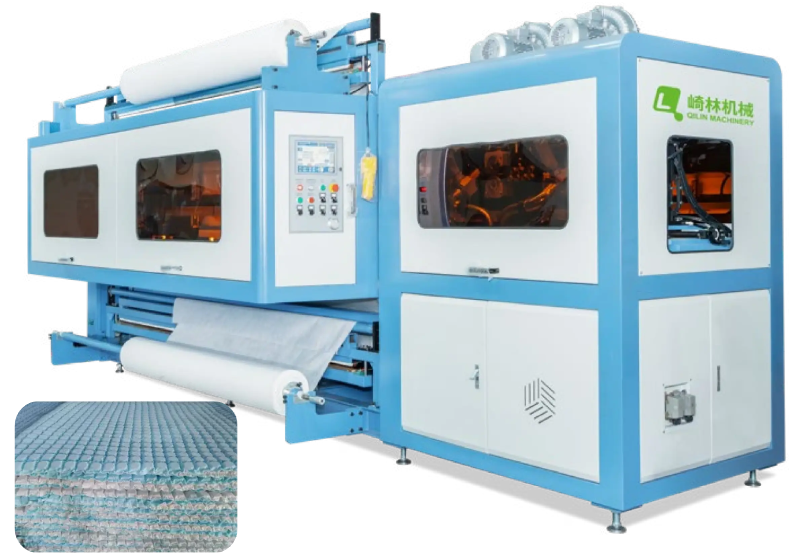
The Efficiency Ceiling of Traditional Single-Channel Gluing Systems
In conventional glue machines without diversion capability, spring units can only move through one fixed path in sequence.
This structure becomes especially problematic under the following conditions:
(1) Multiple pocket spring machines feeding simultaneously
(2) Frequent switching between mattress specifications
(3) Continuous high-volume production
The direct consequences are easy to observe:
(1) Spring units accumulate at the front end
(2) Operators must manually intervene to manage flow
(3) The entire production line is forced to slow down
Even if the gluing action itself is fast, the lack of routing flexibility limits overall throughput.
Design Logic Behind the ZJ8L High-Efficiency Diversion System
The high-efficiency diversion system of the ZJ8L is not a simple addition of conveyor belts. It is a redesign centered on production rhythm.
Its core logic can be summarized in three points.
First, transforming a single-path structure into a multi-path cooperative system.
Second, converting waiting time into controlled buffering time.
Third, replacing manual scheduling with system-based scheduling.
Through the diversion structure, spring units are automatically routed into different paths based on real-time rhythm, rather than accumulating at a single entrance.
This allows the glue machine to shift from a passive receiving station to an active rhythm-regulating station.
Direct Impact of the Diversion System on Production Efficiency
In real production environments, the ZJ8L diversion system improves efficiency on several levels.
The first is effective cycle time reduction.
cURL Too many subrequests.
cURL Too many subrequests.
cURL Too many subrequests.
cURL Too many subrequests.
cURL Too many subrequests.
cURL Too many subrequests.
cURL Too many subrequests.
cURL Too many subrequests.
cURL Too many subrequests.
cURL Too many subrequests.
cURL Too many subrequests.
cURL Too many subrequests.
cURL Too many subrequests.
cURL Too many subrequests.
cURL Too many subrequests.
cURL Too many subrequests.
cURL Too many subrequests.
cURL Too many subrequests.
cURL Too many subrequests.
cURL Too many subrequests.
cURL Too many subrequests.
cURL Too many subrequests.
cURL Too many subrequests.
cURL Too many subrequests.
cURL Too many subrequests.
cURL Too many subrequests.
cURL Too many subrequests.
cURL Too many subrequests.
cURL Too many subrequests.
cURL Too many subrequests.
cURL Too many subrequests.
cURL Too many subrequests.
cURL Too many subrequests.
cURL Too many subrequests.
cURL Too many subrequests.
cURL Too many subrequests.
cURL Too many subrequests.
cURL Too many subrequests.
cURL Too many subrequests.
cURL Too many subrequests.
cURL Too many subrequests.
cURL Too many subrequests.
(4) Improved quality consistency and lower after-sales risk
In many real-world projects, the efficiency gains delivered by the diversion system allow equipment upgrade costs to be recovered within a relatively short period.
This is why more factories choose glue machines with integrated diversion structures when expanding or upgrading their lines.
Summary Table: Value Comparison of Gluing Systems
Evaluation Dimension | Traditional Single-Channel Gluing | ZJ8L High-Efficiency Diversion System
Production rhythm | Serial waiting | Parallel buffering
Peak handling capacity | Prone to congestion | Absorbs fluctuations
Labor involvement | High | Significantly reduced
Specification switching | Frequent stoppages | Buffered transitions
Spring unit stability | Easily stressed | More orderly flow
Line coordination | Passive follower | Active regulator
Conclusion: Diversion Is Not an Add-On, but an Efficiency Structure
In today’s mattress manufacturing environment, the role of a glue machine extends far beyond bonding springs together.
It connects front-end capacity, stabilizes mid-line rhythm, and supports downstream quality.
The high-efficiency diversion system of the ZJ8L glue machine is fundamentally a structural design aimed at whole-line efficiency, not a simple functional upgrade.
For mattress manufacturers pursuing stable output, controllable costs, and long-term competitiveness, this type of system value is often more important than single-point speed parameters.
If you are evaluating glue machine upgrade options, whether the equipment provides truly effective diversion capability deserves a very high priority in the decision process.
 Tibetan
  English
  Vietnamese
  Spanish
  German
  French (France)
  French (Canada)
  Japanese
  German (Austria)
  Danish
  Malayalam
  Indonesian
  Frisian
  Greek
Greek  Javanese
  Macedonian
  Galician