Semi-Automatic vs Fully Automatic Roll Packing Machines: Which Is More Suitable for Your Factory?
In the modern mattress manufacturing industry, packaging efficiency has become a critical factor in determining factory productivity and logistics costs. As global mattress markets expand and online mattress sales increase, manufacturers must improve packaging processes to remain competitive. One of the most important technologies supporting this transformation is the mattress compression and roll packing machine.
Roll packing technology allows mattresses to be compressed, vacuum sealed, and rolled into compact cylindrical packages. This process dramatically reduces the volume of mattresses during storage and transportation. As a result, factories can ship more products in each container and reduce logistics expenses.
When mattress manufacturers invest in packaging equipment, they usually face an important decision: should they choose a semi-automatic roll packing machine or a fully automatic roll packing machine? Each type has its own advantages depending on factory size, production capacity, and investment budget.
Manufacturers that specialize in mattress machinery solutions, such as those introduced on https://mattressmachineryzl.com/, provide both semi-automatic and fully automatic roll packing equipment to meet the needs of different mattress factories.
This article will analyze the differences between semi-automatic and fully automatic roll packing machines and help factory managers determine which option best suits their production environment.
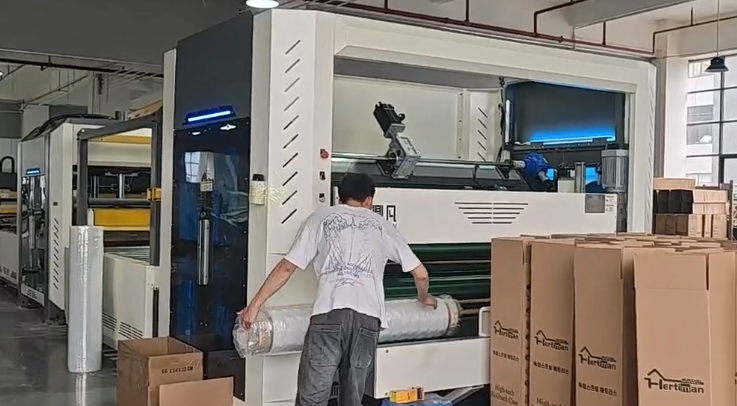
Understanding Mattress Roll Packing Technology
Mattress roll packing is a packaging process designed to reduce the physical size of mattresses for easier transportation and storage. The technology works by compressing the mattress, removing air from the packaging, and rolling the mattress into a compact cylindrical shape.
The typical roll packing process includes several stages:
(1) The mattress is placed into a compression system
(2) Hydraulic pressure compresses the mattress thickness
(3) Vacuum sealing removes air from the packaging film
(4) The mattress is rolled into a cylindrical package
(5) Heat sealing closes the packaging
After packaging, the mattress volume can be reduced by more than half. This allows manufacturers to load significantly more mattresses into shipping containers.
Roll-packed mattresses are also easier to store in warehouses and can be transported through standard logistics networks more efficiently.
What Is a Semi-Automatic Roll Packing Machine?
A semi-automatic roll packing machine performs part of the packaging process automatically while still requiring operator involvement.
In a semi-automatic system, workers typically perform several tasks manually, including placing the mattress on the machine, adjusting the packaging film, and removing the finished roll-packed mattress.
Semi-automatic machines are widely used in small and medium mattress factories. These machines provide efficient packaging capability without requiring a large capital investment.
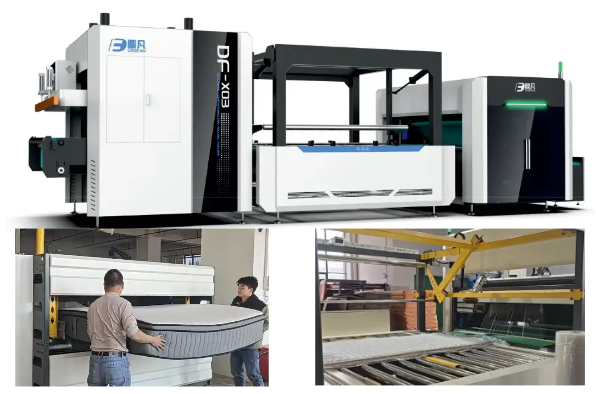
Common characteristics of semi-automatic roll packing machines include:
- relatively simple mechanical structure
- lower equipment cost
- moderate packaging speed
- manual assistance during operation
Machines such as semi-automatic compression roll packing systems or single-axis rolling machines are typical examples used by many mattress manufacturers.
What Is a Fully Automatic Roll Packing Machine?
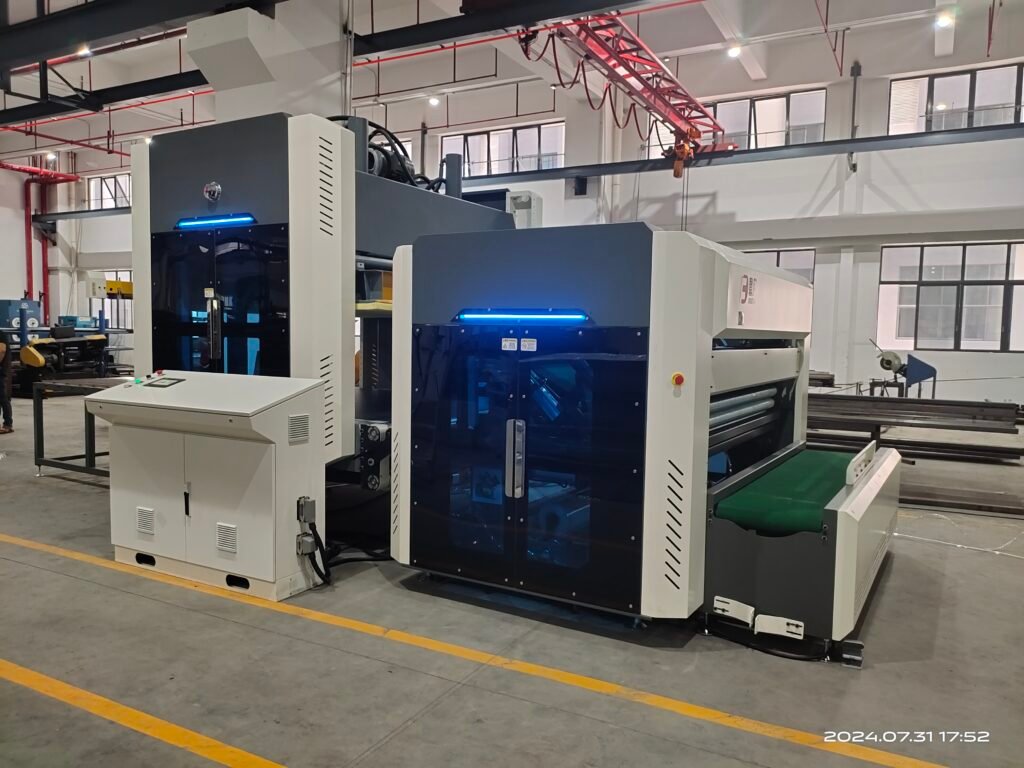
A fully automatic roll packing machine integrates the entire packaging process into a continuous automated system.
These machines are designed to perform all packaging steps without manual assistance.
The typical components of a fully automatic roll packing system include:
- automatic feeding conveyor
- compression unit
- vacuum sealing system
- folding mechanism
- rolling mechanism
- heat sealing system
- intelligent control system
Once the mattress enters the system, the machine automatically completes compression, folding, rolling, and sealing.
Fully automatic machines can operate continuously and maintain stable production speed, which is ideal for large-scale mattress factories.
Many advanced mattress machinery solutions provided on https://mattressmachineryzl.com/ include fully automatic compression and roll packing production lines designed for industrial manufacturing environments.
Structural Differences Between Semi-Automatic and Fully Automatic Machines
Although both machines perform the same packaging function, their internal structures and automation levels are very different.
Semi-automatic machines focus on basic mechanical compression and rolling functions. Fully automatic machines combine multiple intelligent modules and automated control systems.
Below is a comparison of the key structural characteristics.
| Feature | Semi-Automatic Roll Packing Machine | Fully Automatic Roll Packing Machine |
|---|---|---|
| Automation level | Partial automation | Fully automated system |
| Labor requirement | 2–4 workers | 1–2 workers |
| Production speed | Medium | High |
| Equipment cost | Lower | Higher |
| Structural complexity | Simple mechanical structure | Integrated automated modules |
| Maintenance | Easier maintenance | Requires technical support |
| Production capacity | Suitable for medium factories | Suitable for large factories |
These structural differences influence factory productivity and long-term operational efficiency.
Advantages of Semi-Automatic Roll Packing Machines
Semi-automatic machines remain a popular choice for many mattress manufacturers.
One of the biggest advantages is the lower initial investment cost. Small factories can adopt roll packing technology without purchasing expensive automated systems.
Another advantage is operational flexibility. Because operators participate in the packaging process, semi-automatic machines can easily handle customized mattress sizes or special packaging requirements.
Semi-automatic machines also have simpler mechanical designs, which makes maintenance easier and less expensive.
Factories that produce a few hundred mattresses per day can usually achieve satisfactory efficiency with semi-automatic equipment.
Advantages of Fully Automatic Roll Packing Machines
Fully automatic roll packing machines provide significant benefits for large-scale mattress production.
The most important advantage is high packaging efficiency. Fully automated machines can process mattresses continuously without interruption.
Many modern systems can package one mattress approximately every 30 seconds. This high speed significantly increases factory productivity.
Another advantage is reduced labor cost. Automation allows factories to operate packaging lines with very few workers.
Fully automatic machines also provide consistent packaging quality. Because the machine controls compression pressure, rolling diameter, and sealing temperature automatically, every mattress package meets the same standards.
These systems can also be integrated directly into mattress production lines, creating a seamless manufacturing workflow.
hw-remosaic: 0;
touch: (0.49722221, 0.49722221);
modeInfo: ;
sceneMode: LLHDR;
cct_value: 0;
AI_Scene: (-1, -1);
aec_lux: 244.0061;
hist255: 0.0;
hist252~255: 0.0;
hist0~15: 0.0;
Production Capacity Comparison
Production capacity is an important factor when selecting packaging equipment.
The output difference between semi-automatic and fully automatic machines is significant.
| Production Indicator | Semi-Automatic Machine | Fully Automatic Machine |
|---|---|---|
| Packaging speed | 40–60 seconds per mattress | Around 30 seconds per mattress |
| Daily production | 500–800 mattresses | 1500–2500 mattresses |
| Labor requirement | Several operators | Minimal staff |
| Production stability | Depends on operator skill | Highly stable automated process |
For factories producing large volumes of mattresses, fully automatic machines offer substantial efficiency advantages.
Cost Considerations for Factory Owners
When choosing packaging equipment, factory owners should analyze both short-term and long-term costs.
Important factors include:
(1) Equipment purchase cost
(2) Labor expenses
(3) Production efficiency
(4) Maintenance costs
(5) Future production expansion
Although fully automatic machines require a larger initial investment, they often provide better long-term economic value because of reduced labor costs and higher productivity.
Which Machine Is More Suitable for Small Factories?
Small mattress factories often prefer semi-automatic machines.
These factories usually have moderate production capacity and limited budgets.
Semi-automatic machines provide reliable roll packing capability while maintaining manageable equipment costs.
They also allow factories to gradually increase automation levels as their production volume grows.
Which Machine Is More Suitable for Large Factories?
Large mattress manufacturers usually benefit more from fully automatic roll packing machines.
These factories often operate high-speed production lines and ship large quantities of mattresses to international markets.
Fully automatic machines support continuous operation and integrate easily with automated production systems.
When connected to intelligent conveyor systems and packaging lines, they can significantly increase overall factory productivity.
Many large factories adopt integrated packaging solutions similar to those offered by mattress machinery manufacturers on https://mattressmachineryzl.com/.
Future Trends in Mattress Packaging Technology
The mattress industry is rapidly moving toward higher levels of automation.
Several trends are shaping the future of mattress packaging equipment.
Smart manufacturing systems are becoming increasingly common in modern mattress factories. These systems connect production equipment, packaging machines, and logistics operations into unified automated workflows.
Energy-efficient equipment designs are also gaining attention as factories aim to reduce operating costs.
Another important trend is flexible manufacturing. Future packaging machines will be capable of handling multiple mattress types and packaging formats.
Conclusion
Mattress roll packing technology has transformed the way mattresses are transported and stored.
By compressing and rolling mattresses into compact packages, manufacturers can significantly reduce logistics costs and improve warehouse efficiency.
When choosing between semi-automatic and fully automatic roll packing machines, factory managers should carefully evaluate production scale, investment budget, and long-term development goals.
Semi-automatic machines are suitable for small and medium factories that require flexible operation and lower investment costs.
Fully automatic machines are ideal for large manufacturers seeking higher efficiency, lower labor costs, and stable production performance.
Both types of machines play important roles in the mattress manufacturing industry.
Factories looking to upgrade their packaging technology can explore advanced mattress machinery solutions and roll packing equipment available on https://mattressmachineryzl.com/.
Choosing the right packaging equipment today can help mattress manufacturers improve efficiency, reduce costs, and strengthen their competitiveness in the global market.
 English
  Vietnamese
  Spanish
  German
  French (France)
  French (Canada)
  Japanese
  German (Austria)
  Tibetan
  Danish
  Malayalam
  Indonesian
  Frisian
  Greek
Greek  Javanese
  Macedonian
  Galician