
The Intelligent Upgrade Path for Mattress Manufacturing Factories
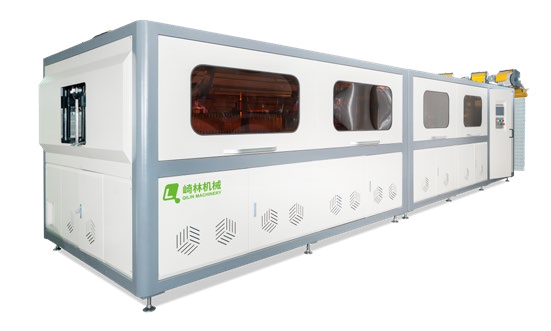
In the global mattress industry, competition is no longer driven only by product design or raw material selection. It is increasingly shaped by manufacturing capability. Rising labor costs, growing product complexity, shorter delivery cycles, and higher quality expectations are forcing mattress factories to rethink how they operate.
An intelligent upgrade is not a single equipment purchase or a sudden transformation. It is a structured, step-by-step evolution that reshapes production logic, workforce roles, and factory architecture over time. Factories that approach intelligent upgrading systematically gain sustainable advantages, while those that rely on fragmented automation often struggle with instability and rising costs.
This article outlines a practical and realistic intelligent upgrade path for mattress manufacturing factories, based on production flow, automation logic, and long-term operational goals rather than abstract digital concepts.
For reference to relevant equipment and integrated production solutions, you may consult the internal company page:
https://mattressmachineryzl.com/
Understanding What “Intelligent Manufacturing” Means in Mattress Production
Intelligent manufacturing in mattress factories does not mean replacing every worker with machines or implementing complex IT systems overnight. In practical terms, it means:
- Reducing dependence on manual judgment
- Embedding consistency into processes
- Connecting individual machines into coordinated systems
- Allowing production to adapt automatically to change
The goal is stable, predictable, and scalable production, not maximum automation for its own sake.
Stage One: Stabilizing Core Production Processes
The first step in intelligent upgrading is process stabilization.
Many factories attempt to automate before their processes are stable. This leads to automation amplifying existing problems rather than solving them.
At this stage, factories should focus on:
- Standardizing operating parameters
- Eliminating excessive manual adjustment
- Reducing quality variation between shifts
Key equipment upgrades often include:
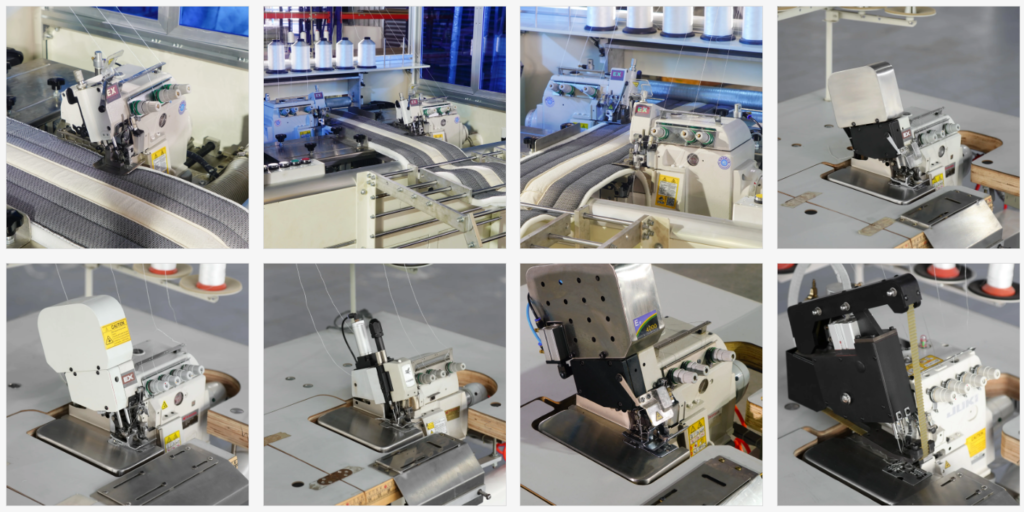
- More stable sewing and tape edge machines
- Controlled glue spraying systems
- Accurate cutting and feeding equipment
Stability is the foundation. Without it, higher-level automation cannot succeed.
Stage Two: Replacing High-Intensity Manual Handling
Once core processes are stable, the next upgrade priority is material handling.
Manual handling consumes large amounts of labor and creates safety risks. It also introduces inconsistency and limits production speed.
Intelligent upgrading at this stage typically includes:
- Automated conveying systems
- Mattress flipping and turning equipment
- Automatic stacking or buffering systems
By removing manual carrying, lifting, and repositioning, factories often achieve immediate labor savings and smoother production flow.
Stage Three: Connecting Processes into Continuous Flow
Many factories operate with automated machines that are still functionally isolated.
The next step is to connect these machines into a continuous production flow. This involves:
- Synchronizing machine cycle times
- Eliminating batch-based movement
- Reducing waiting and accumulation
Automated conveying becomes the backbone of the line, allowing products to move automatically between processes without human intervention.
This stage marks the transition from machine automation to line automation.
Stage Four: Introducing Intelligent Coordination and Control Logic
Once processes are connected, intelligence shifts from hardware to control logic.
At this stage, factories introduce:
- Centralized PLC control
- Recipe-based production management
- Automatic adjustment based on product type
Machines no longer operate based only on local settings. They respond to shared production logic, allowing the line to adapt automatically to different mattress models.
This is a critical step toward flexible manufacturing.
Stage Five: Automating Complex Process Transitions
In mattress production, complexity often lies in transitions rather than core operations.
Examples include:
- Layer separation and insertion
- Orientation changes between processes
- Switching between top and bottom surface processing
Automatic layer-changing machines, flipping units, and alignment systems address these challenges.
By automating transitions, factories eliminate some of the most labor-intensive and error-prone operations, significantly improving overall efficiency.
Stage Six: Building Buffering and Storage Intelligence
As production speed increases, buffering becomes essential.
Intelligent factories do not rely on random accumulation. They design:
- Multi-layer conveying and storage systems
- Controlled buffer logic
- Automated release based on downstream demand
This allows different parts of the factory to operate at optimal speeds without stopping the entire line.
Buffering intelligence is especially important for 24-hour operation.
Stage Seven: Enabling Data-Driven Monitoring and Feedback
At higher levels of intelligent upgrading, factories begin to use data not just for reporting, but for real-time decision support.
Key developments include:
- Monitoring equipment status and utilization
- Tracking production rhythm and downtime
- Identifying recurring bottlenecks
This data supports continuous improvement rather than reactive troubleshooting.
Stage Eight: Supporting 24-Hour Continuous Operation
True intelligent manufacturing enables stable round-the-clock operation.
This requires:
- Reduced labor dependency
- Predictable machine behavior
- Automated handling and storage
- Reliable fault detection
Factories at this stage can run night shifts with minimal staff, maximizing asset utilization and reducing unit production cost.
Workforce Transformation as Part of the Upgrade Path
Intelligent upgrading does not eliminate the workforce. It transforms it.
As automation increases:
- Physical labor decreases
- Monitoring and coordination roles increase
- Skill requirements shift from manual execution to system understanding
Successful factories invest in retraining rather than replacement, ensuring that human experience complements automated systems.
Avoiding Common Pitfalls in Intelligent Upgrading
Many intelligent upgrade projects fail due to:
- Automating unstable processes
- Purchasing isolated equipment without system planning
- Underestimating integration complexity
- Ignoring operator training
A successful upgrade follows a logical sequence, not a checklist.
Intelligent Upgrading Is a Continuous Journey
There is no final stage where a factory becomes “fully intelligent.”
Markets change. Products evolve. Technology advances.
An intelligent factory is one that can:
- Adapt without major disruption
- Scale capacity without linear labor growth
- Maintain quality under increasing complexity
This adaptability is the true measure of intelligence.
Summary Table: Intelligent Upgrade Path for Mattress Manufacturing Factories
Upgrade Stage | Focus Area | Primary Value
Process stabilization | Consistency and quality | Reduced variation
Handling automation | Labor reduction | Improved safety and flow
Line integration | Continuous production | Higher efficiency
Control intelligence | Flexible manufacturing | Faster changeover
Transition automation | Error reduction | Stable complex processes
Buffering systems | Rhythm balancing | 24-hour readiness
Data monitoring | Continuous improvement | Predictable operation
Why Intelligent Upgrading Is a Strategic Decision
Intelligent upgrading is not simply about reducing cost. It reshapes how a factory competes.
Factories that upgrade intelligently gain:
- Faster response to market demand
- Lower dependency on labor markets
- Higher and more consistent quality
- Better utilization of space and equipment
These advantages compound over time.
The Role of Integrated Solution Providers
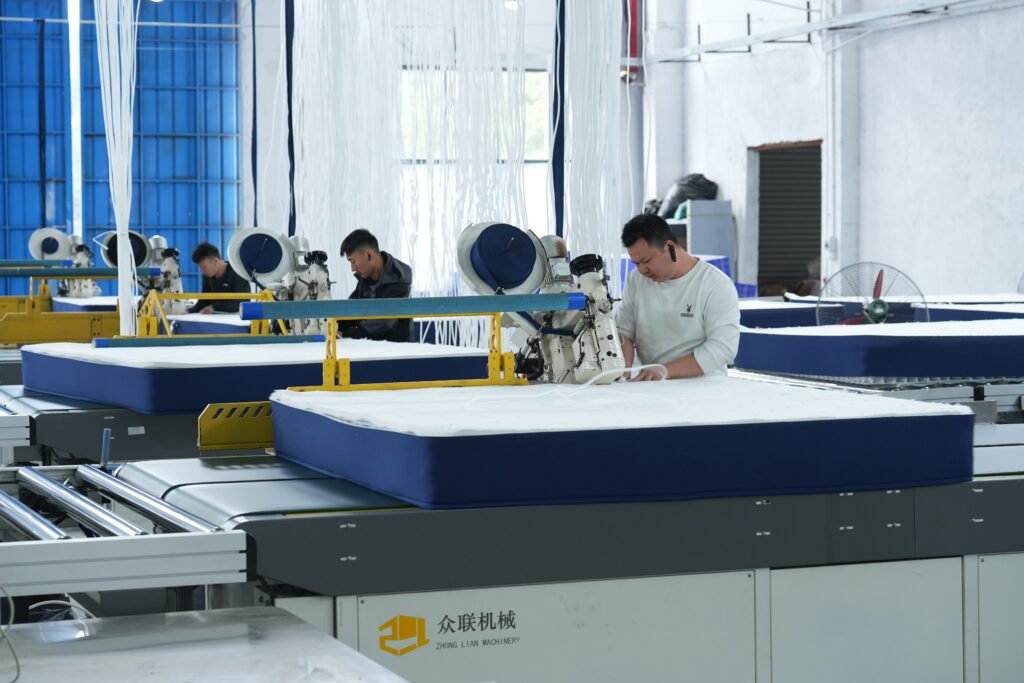
Because intelligent upgrading affects the entire factory, it cannot be approached through isolated equipment purchases alone.
Factories benefit most when working with solution providers that understand:
- Mattress production logic
- Equipment integration
- Line-level coordination
Integrated solutions reduce risk and accelerate results.
More information about integrated production concepts can be found internally at:
https://mattressmachineryzl.com/
Conclusion: From Automation to Intelligence
The intelligent upgrade path for mattress manufacturing factories is not about replacing people with machines. It is about designing a production system that is stable, flexible, and scalable.
By progressing step by step—from stabilizing processes to automating handling, integrating lines, introducing intelligent control, and enabling continuous operation—factories can achieve sustainable competitive advantage.
Intelligent manufacturing is not a destination. It is a structured way of building a factory that can grow, adapt, and perform consistently in an increasingly demanding global mattress market.
 English
  Vietnamese
  Spanish
  German
  French (France)
  French (Canada)
  Japanese
  German (Austria)
  Tibetan
  Danish
  Malayalam
  Indonesian
  Frisian
  Greek
Greek  Javanese
  Macedonian
  Galician