Three-Machine Integration: An Intelligent Production Solution Combining Pocket Spring Machines and Gluing Systems
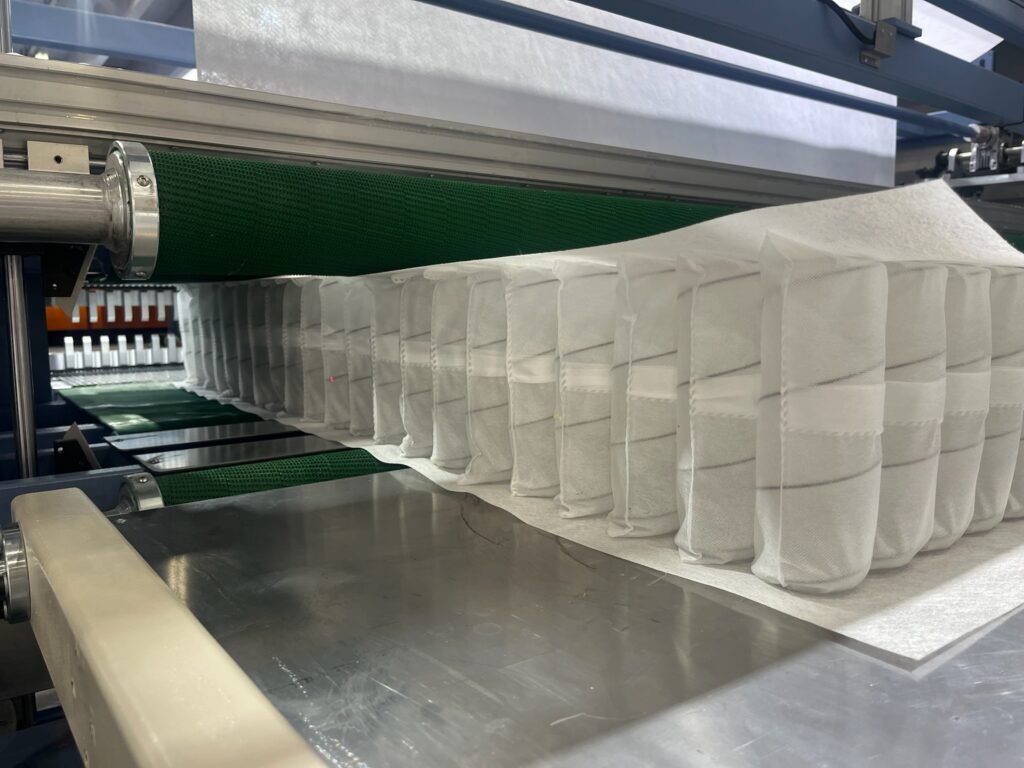
As mattress production technology becomes increasingly automated and sophisticated, factories around the world are searching for ways to improve efficiency, reduce labor, and enhance product consistency. One of the most transformative developments I have observed is the growing adoption of three-machine linkage systems—an integrated production setup that combines pocket spring machines, pocket spring assembly equipment, and automated gluing machines into one continuous line. This intelligent combination represents a significant step toward Industry 4.0-level mattress manufacturing and has already reshaped production standards in many factories I’ve visited.
When I first encountered a fully linked three-machine system, I realized it solved several long-standing bottlenecks in mattress factories. These include inconsistent spring-unit quality, high labor dependence, production interruptions between machines, and inefficient workflows caused by manual transfer of spring units. By integrating the coiling machine, pocket assembly machine, and gluing machine into a synchronized line, manufacturers can achieve stable, high-volume output while maintaining strong control over precision and material usage.
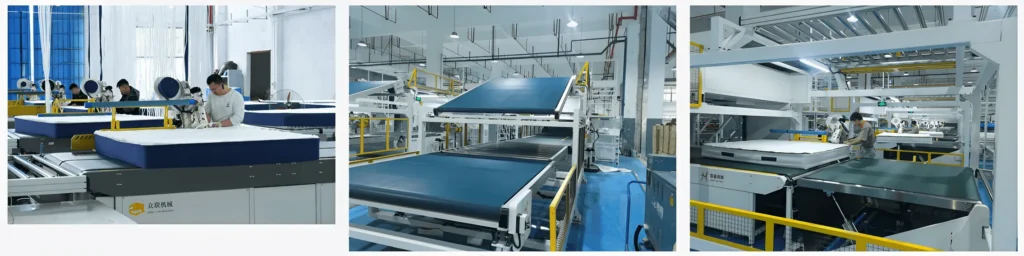
In this article, I will explore the engineering logic behind three-machine integration, explain how it improves efficiency and product quality, describe the roles of each component machine, and highlight the operational advantages this system provides to modern mattress manufacturers. I will also include a detailed comparison table that illustrates the performance differences between traditional stand-alone machines and a fully linked intelligent system.
Why Mattress Factories Are Moving Toward Integrated Production
Traditional mattress factories often operate their pocket spring machines, assembly machines, and gluing stations as separate units. This creates unnecessary friction in workflow. Operators must manually transfer spring chains, reorder them, realign them, and perform repetitive tasks that increase labor cost and slow down production.
Factories upgrading to an integrated three-machine system typically face similar challenges beforehand:
- irregular production timing between machines
- product inconsistencies caused by manual handling
- accumulation of spring units waiting for processing
- higher labor requirements
- greater material waste due to handling mistakes
- unstable production output
As global demand grows and competition tightens, these inefficiencies make it difficult for factories to scale production smoothly. A three-machine linkage eliminates these issues by enabling continuous, automated flow from spring coiling to final gluing.
Understanding the Three-Machine Intelligent Integration System
A three-machine linked system includes:
(1)Pocket spring coiling machine
This machine produces springs, inserts them into non-woven fabric, and cuts them into pocket spring chains.
(2)Pocket spring assembly or row-welding machine
This machine aligns and joins individual rows of pocket springs into wider spring units.
(3)Full-automatic or semi-automatic gluing machine
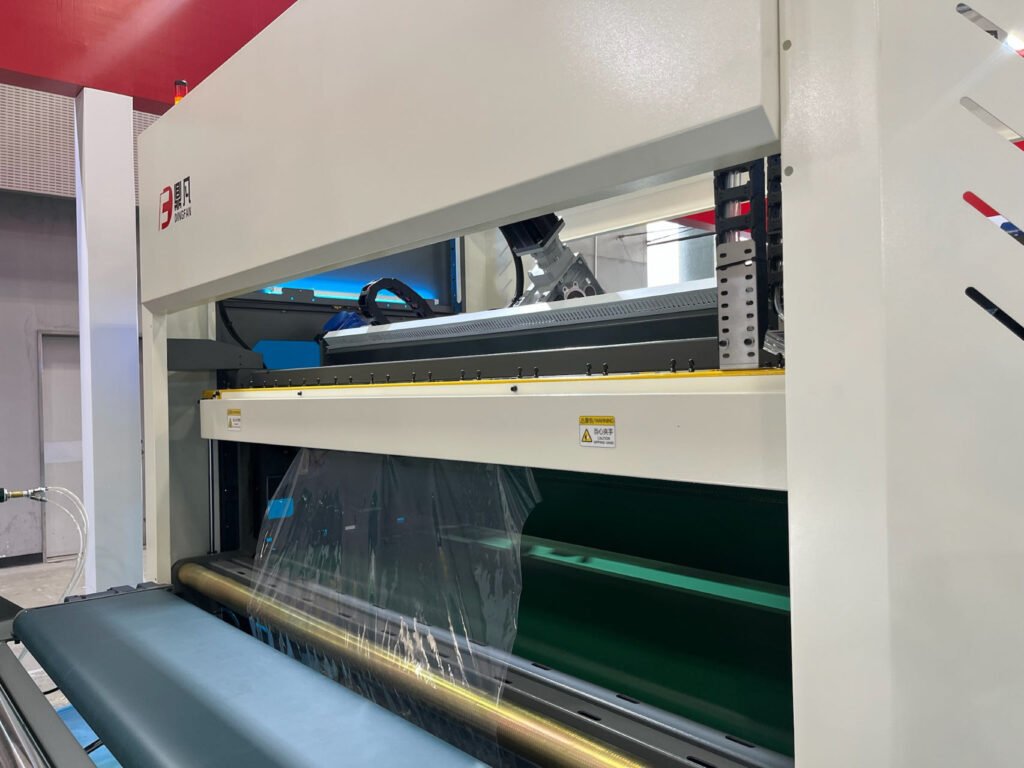
This system bonds the assembled rows into a complete mattress core.
When these machines operate separately, factories must coordinate them manually. When linked, they form a unified, intelligent production line capable of self-adjusting flow rates, synchronizing operations, and improving consistency across all production stages.

How Each Machine Contributes to the Integrated Workflow
To understand how integration enhances performance, it is essential to analyze the roles of the individual machines.
(1)Pocket Spring Machine: The Source of Precision
The pocket spring machine is responsible for:
- wire coiling
- pocket welding
- cutting
- row shaping
In an integrated system, the spring machine’s output is synchronized with the downstream assembly machine. This prevents pile-ups and ensures a steady flow of rows.
A well-designed pocket spring machine ensures:
- accurate spring height
- consistent pitch
- stable ultrasonic sealing
- reduced fabric waste
- predictable output timing
When this consistency flows into the next machine automatically, the entire production line benefits.
(2)Assembly Machine: The Bridge Between Coiling and Gluing
The assembly machine welds spring rows into a full-size spring unit. This machine determines:
- unit width
- row alignment
- bonding pattern
- zone configuration possibilities
When integrated into a three-machine system, the assembly machine communicates with both the upstream coiling machine and downstream gluing machine, adjusting its speed and timing. This automation prevents bottlenecks and ensures uniform product dimensions.
(3)Gluing Machine: The Final Structural Step
The gluing machine bonds the assembled spring layers into a stable mattress core. Precision in this step determines:
- mattress flatness
- structural durability
- internal noise level
- long-term stability
In an integrated system, the gluing machine receives spring units automatically. Sensors detect incoming units, adjust glue patterns, and synchronize conveyor speed without operator intervention.
Key Advantages of Three-Machine Intelligent Integration
Through years of evaluating mattress factories, I have consistently observed six major performance enhancements after transitioning to a three-machine linkage system.
(1)Significant Reduction in Labor Requirements
Before integration, each machine requires its own set of operators:
- one for the pocket spring machine
- one for the assembly machine
- one or two for the gluing machine
With automated linkage, labor demand drops sharply. Operators are needed only for supervision and quality checks, reducing labor by 40–60%.
(2)Elimination of Manual Handling Errors
Manual transfer of spring units often results in:
- misalignment
- tearing of pockets
- contamination from dust or glue
- deformation of spring rows
Integrated conveyors and sensors eliminate these risks entirely.
(3)Improved Production Consistency
The most consistent factories are those where machines operate in harmony. A linked system ensures:
- identical timing cycles
- stable glue patterns
- uniform row spacing
- predictable output flow
This consistency directly translates to higher mattress quality.
(4)Higher Production Throughput
Because integrated machines operate without interruption, factories typically experience:
- 20–50% higher daily output
- shorter cycle times
- higher uptime across shifts
Even a small reduction in downtime produces significant improvements over long production cycles.
(5)Reduced Glue and Material Waste
Material waste often results from:
- poor alignment
- inconsistent spring rows
- incorrect spacing
- over-gluing
Because the integrated system stabilizes upstream processes, glue consumption becomes more predictable, and waste often decreases by 20–30%.
(6)Enhanced Compatibility With Premium Mattress Designs
Three-machine linkage supports:
- multi-zone pocket spring configurations
- hybrid mattress models
- tall spring units
- high-density spring layouts
This enables factories to expand into higher-value product lines.
Production Workflow Improvements After Integration
A fully integrated line improves workflow stability through:
(1)auto-balancing of machine speeds
(2)intelligent load distribution
(3)real-time error detection
(4)smoother transitions between machines
(5)continuous conveyor-driven movement
Combined, these improvements greatly reduce bottlenecks.
Comparison Table: Stand-Alone Machines vs Three-Machine Integration
| Performance Indicator | Stand-Alone Machines | Three-Machine Linked System | Practical Impact |
|---|---|---|---|
| Labor Requirement | High | Very Low | Cost savings |
| Production Consistency | Medium | Very High | Stronger mattress quality |
| Glue Consumption | High | Medium-Low | Reduced operating cost |
| Unit Alignment | Variable | Precisely controlled | Flatter, more stable spring units |
| Output Speed | Moderate | Fast & continuous | Higher daily capacity |
| Error Rate | High | Low | Fewer rejects |
| Suitability for Large Orders | Medium | Excellent | Better scalability |
| Automation Level | Low–Medium | High | Predictable production planning |
Dive Deeper: The Engineering Logic Behind Machine Synchronization
In a three-machine integration system, synchronization is more than just matching speed. It involves:
- sensor-driven communication
- servo-controlled motor adjustments
- real-time feedback loops
- adaptive conveyor timing
For example, if the gluing machine temporarily slows due to glue temperature adjustment, the assembly machine automatically adjusts its feed rate, and the pocket spring machine decreases its output speed to prevent overload.
This self-balancing mechanism creates an intelligent manufacturing workflow where machines behave more like coordinated components of a single system.
Dive Deeper: Economic Benefits of Three-Machine Integration
Beyond technical improvements, the business value is substantial:
(1)lower labor cost
(2)lower defect-related loss
(3)higher machine utilization rate
(4)lower total glue consumption
(5)greater competitiveness in export markets
(6)faster order fulfillment
Many factories achieve payback on the integrated system within one to two years.
Conclusion: Three-Machine Integration as the Future of Mattress Manufacturing
After analyzing its performance, observing its operation in multiple factories, and comparing it with traditional setups, I believe the three-machine linkage system represents a major technological leap for mattress manufacturers. It improves consistency, reduces labor cost, increases speed, and enhances product quality—all while enabling factories to expand into higher-value product segments.
Factories adopting this intelligent integration typically experience:
- 20–50% higher output
- 40–60% labor reduction
- 20–30% material savings
- stronger structural consistency
- improved customer satisfaction
In a competitive global market, integrated automation is no longer optional—it is the new standard for efficient and scalable mattress production.
 English
  Vietnamese
  Spanish
  German
  French (France)
  French (Canada)
  Japanese
  German (Austria)
  Tibetan
  Danish
  Malayalam
  Indonesian
  Frisian
  Greek
Greek  Javanese
  Macedonian
  Galician