Precision Analysis of the ZL-BD-C Automatic Mattress Side Fabric Cutting Machine
In mattress manufacturing, side fabric cutting is often underestimated. It happens early in the production process, long before sewing, tape edging, or final assembly. However, this step defines the geometric accuracy of the entire mattress side border. Once a side fabric panel is cut inaccurately, no downstream process can fully correct the error without added labor, rework, or material waste.
The ZL-BD-C automatic mattress side fabric cutting machine was developed to solve this exact problem. Its core value lies not in speed alone, but in its ability to deliver repeatable, industrial-level precision under continuous production conditions.
This article provides a comprehensive analysis of the precision performance of the ZL-BD-C, explaining how its structure, control logic, and process design ensure dimensional accuracy, stability, and consistency in real mattress factory environments.
For reference to related equipment and integrated production solutions, you may consult the internal company page:
https://mattressmachineryzl.com/
Why Side Fabric Cutting Precision Is a Critical Foundation
The side fabric panel determines the perimeter of the mattress. Its length, straightness, and angle accuracy directly affect how smoothly the panel can be sewn, how evenly the side border aligns, and how clean the final product appears.
Cutting precision influences:
- Straightness of side border seams
- Alignment during side border sewing
- Symmetry around the mattress perimeter
- Consistency between mattresses in the same batch
- Material utilization and waste rate
In high-volume production, a length deviation of even a few millimeters can lead to cumulative problems such as puckering, forced stretching during sewing, or misaligned corners.
Precision at the cutting stage therefore sets the upper limit for overall side border quality.
Common Precision Problems in Traditional Cutting Processes
Manual and semi-automatic cutting methods rely heavily on operator judgment and physical handling. This creates unavoidable variability.
Typical precision issues include:
- Length inconsistency due to manual measurement
- Fabric stretch caused by uneven tension
- Angle deviation at the panel ends
- Progressive error caused by operator fatigue
These issues often remain hidden until sewing begins, where operators must compensate manually. This increases labor dependency and reduces overall process stability.
The ZL-BD-C was designed specifically to eliminate these upstream inaccuracies.
Precision-Oriented Design Philosophy of the ZL-BD-C
The ZL-BD-C is built around one central principle: cutting accuracy must be controlled by the machine, not by the operator.
Rather than depending on visual judgment or repeated manual adjustment, the machine embeds precision into:
- Fabric feeding
- Length measurement
- Cutting motion
- Structural stability
This design philosophy ensures that every side fabric panel is produced according to the same geometric rules.
Stable Fabric Feeding as the Basis of Accuracy
Precise cutting is impossible without stable fabric feeding.
The ZL-BD-C uses a controlled feeding system that maintains uniform fabric tension throughout the cutting process. This prevents:
- Unintentional stretching
- Slippage during advancement
- Length fluctuation between cuts
By stabilizing fabric behavior before cutting, the machine ensures that the defined cutting length corresponds exactly to the physical fabric length.
This feeding stability is especially important when handling elastic or quilted side fabrics.
Parameter-Based Length Control
One of the most important precision features of the ZL-BD-C is parameterized length control.
Operators input the required side fabric length directly into the control system. Once set, the machine executes this value consistently for every cut.
This approach:
- Eliminates manual measurement error
- Ensures uniform length across batches
- Allows fast switching between mattress sizes
For factories producing multiple mattress models, this parameter-based control significantly improves both precision and efficiency.
Clean and Straight Cutting Path Execution
Precision is not limited to length. Edge quality and straightness also matter.
The ZL-BD-C is engineered to produce:
- Straight cutting lines
- Clean fabric edges
- Minimal fraying or distortion
A clean cut edge allows the fabric to feed smoothly into downstream sewing machines and reduces the risk of seam waviness or edge distortion.
Angle Accuracy at Fabric Ends
Accurate end angles are essential for side border alignment.
If the fabric ends are not cut squarely, seams become twisted during assembly, leading to visual defects and uneven tension.
The ZL-BD-C maintains angle accuracy by:
- Stabilizing fabric orientation during feeding
- Guiding the cutting motion precisely
- Preventing fabric drift before and during cutting
This ensures that side panels align cleanly when joined, improving symmetry around the mattress perimeter.
Repeatability Across Long Production Runs
Precision must be maintained not only during initial setup, but throughout extended production cycles.
The ZL-BD-C achieves long-term repeatability through:
- Rigid machine frame design
- Reduced vibration during operation
- Consistent motion control
These factors prevent gradual drift in cutting accuracy, ensuring that the first and last panels in a production run meet the same dimensional standards.
Reduced Dependence on Operator Skill
In traditional cutting processes, accuracy depends on operator experience and concentration.
With the ZL-BD-C:
- Accuracy is defined by machine parameters
- Operators focus on loading and monitoring
- Training time is significantly reduced
This shift improves consistency across shifts and minimizes quality variation caused by personnel changes.
Precision at High Production Speeds
In many machines, precision degrades as speed increases. The ZL-BD-C is designed to maintain accuracy even under high-throughput conditions.
Its controlled feeding and cutting coordination ensure that:
- Speed changes do not affect length accuracy
- Fabric remains stable during rapid operation
- Output quality remains consistent
This makes the ZL-BD-C suitable for factories that require both high output and tight dimensional control.
Contribution to Material Utilization Efficiency
Accurate cutting directly reduces material waste.
By eliminating overcutting, undercutting, and correction trimming, the ZL-BD-C:
- Improves fabric yield per roll
- Reduces scrap rates
- Simplifies inventory planning
Over time, improved material utilization translates into significant cost savings.
Downstream Benefits for Sewing and Assembly
Precision at the cutting stage simplifies all downstream processes.
Uniform side fabric panels:
- Feed smoothly into side border sewing machines
- Require fewer manual adjustments
- Reduce rework caused by misalignment
This allows sewing and tape edging equipment to operate within their optimal range rather than compensating for upstream inaccuracies.
The ZL-BD-C integrates well into automated or semi-automated side border production lines.
More information about integrated production solutions can be found internally at:
https://mattressmachineryzl.com/
Long-Term Precision Stability and Maintenance Considerations
Precision must be preserved over the machine’s service life.
The ZL-BD-C is designed to:
- Minimize wear-related misalignment
- Maintain calibration stability
- Reduce the need for frequent mechanical adjustment
This long-term stability protects cutting accuracy and prevents gradual quality degradation that might otherwise go unnoticed.
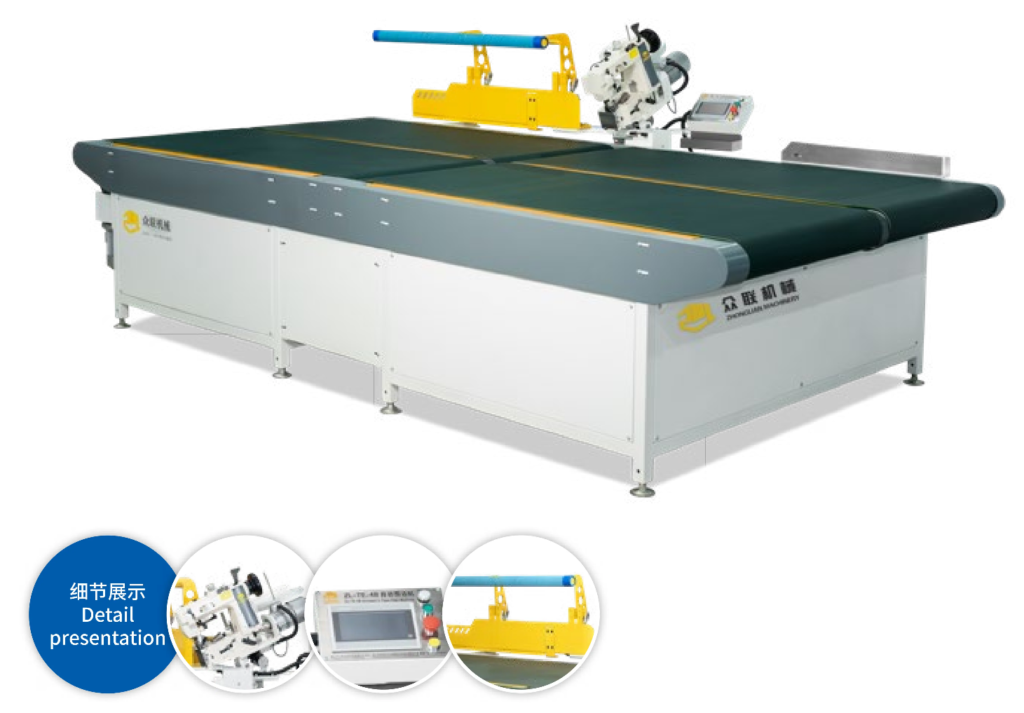
Summary Table: Precision Performance Comparison of Side Fabric Cutting Methods
Precision Factor | Traditional Cutting Method | ZL-BD-C Automatic Cutting Machine
Length consistency | Operator-dependent | Parameter-controlled and repeatable
Edge straightness | Variable | Clean and straight
End angle accuracy | Difficult to maintain | Stable and precise
Repeatability | Low | High across batches
Labor dependency | High | Significantly reduced
Material waste | Higher | Lower
Why Cutting Precision Determines Overall Side Border Quality
Side fabric cutting defines the geometric foundation of the mattress side border. If this foundation is inconsistent, downstream sewing must compensate, increasing labor, reducing consistency, and limiting scalability.
By delivering stable, repeatable cutting precision, the ZL-BD-C raises the overall quality ceiling of side border production. It allows sewing, tape edging, and finishing equipment to operate efficiently without correction-driven intervention.
Conclusion: Precision as a Strategic Capability
The ZL-BD-C automatic mattress side fabric cutting machine demonstrates that precision is not a single function, but the result of coordinated mechanical design, controlled feeding, parameterized length control, and long-term stability.
For mattress manufacturers seeking higher consistency, lower waste, reduced labor dependency, and better integration with automated production lines, cutting precision is a strategic capability. The ZL-BD-C delivers that capability at the very start of the side border process, where it has the greatest impact on overall product quality.
 English
  Vietnamese
  Spanish
  German
  French (France)
  French (Canada)
  Japanese
  German (Austria)
  Tibetan
  Danish
  Malayalam
  Indonesian
  Frisian
  Greek
Greek  Javanese
  Macedonian
  Galician