
Why Intelligent Production Lines Are Safer and More Efficient Than Traditional Manufacturing Models
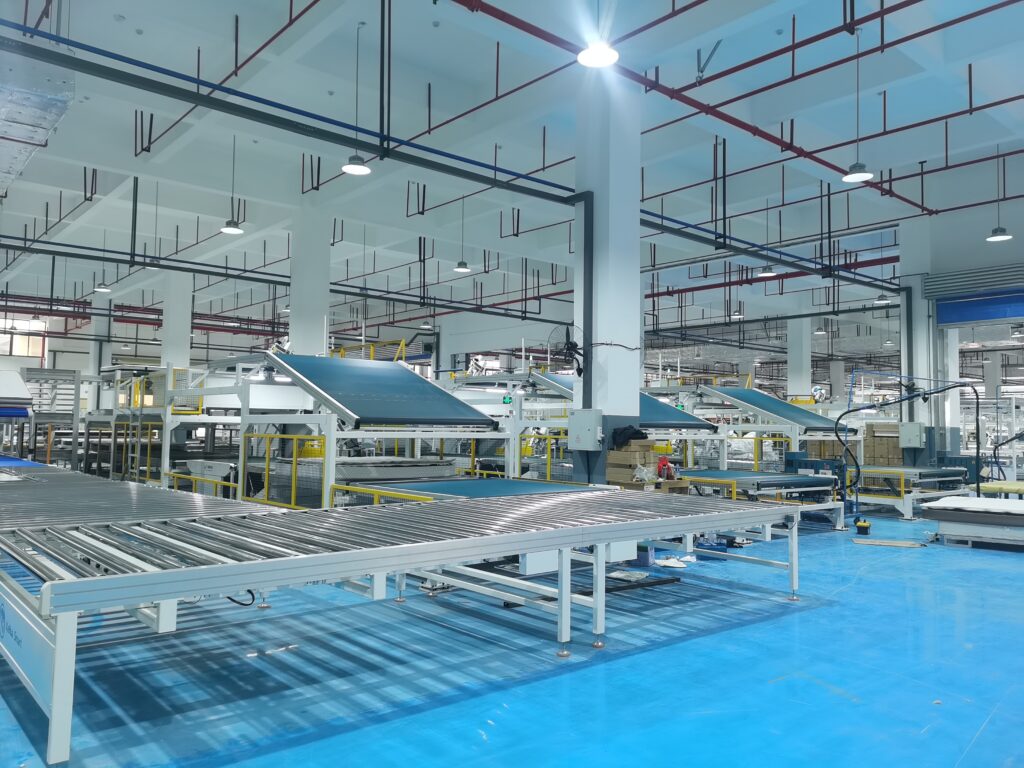
In mattress manufacturing, production efficiency and workplace safety have traditionally been treated as two separate objectives. Management teams often assume that increasing speed raises safety risks, while stricter safety measures reduce output. This trade-off mindset is rooted in traditional production models, where human labor is deeply embedded in every step of the process.
Intelligent production lines challenge this assumption. By redesigning how work is performed, how machines interact, and how people participate in production, intelligent lines achieve higher efficiency and higher safety at the same time. These improvements are not marginal. In many factories, they represent a fundamental shift in operational capability.
This article explains why intelligent production lines outperform traditional models in both safety and efficiency, focusing on real manufacturing logic rather than abstract automation theory.
For reference to integrated equipment and intelligent production solutions, you may consult the internal company page:
https://mattressmachineryzl.com/
Understanding the Core Difference Between Traditional and Intelligent Production
The difference between traditional and intelligent production lines is not the number of machines or the level of automation alone. It is where decision-making and control reside.
In traditional production:
- People decide when to move products
- Workers adjust machines based on experience
- Safety relies heavily on individual awareness
In intelligent production:
- Systems decide process timing
- Machines adjust automatically based on data
- Safety is embedded into design and control logic
This shift removes uncertainty, which is the root cause of both inefficiency and accidents.
Traditional Production Models Are Built Around Human Compensation
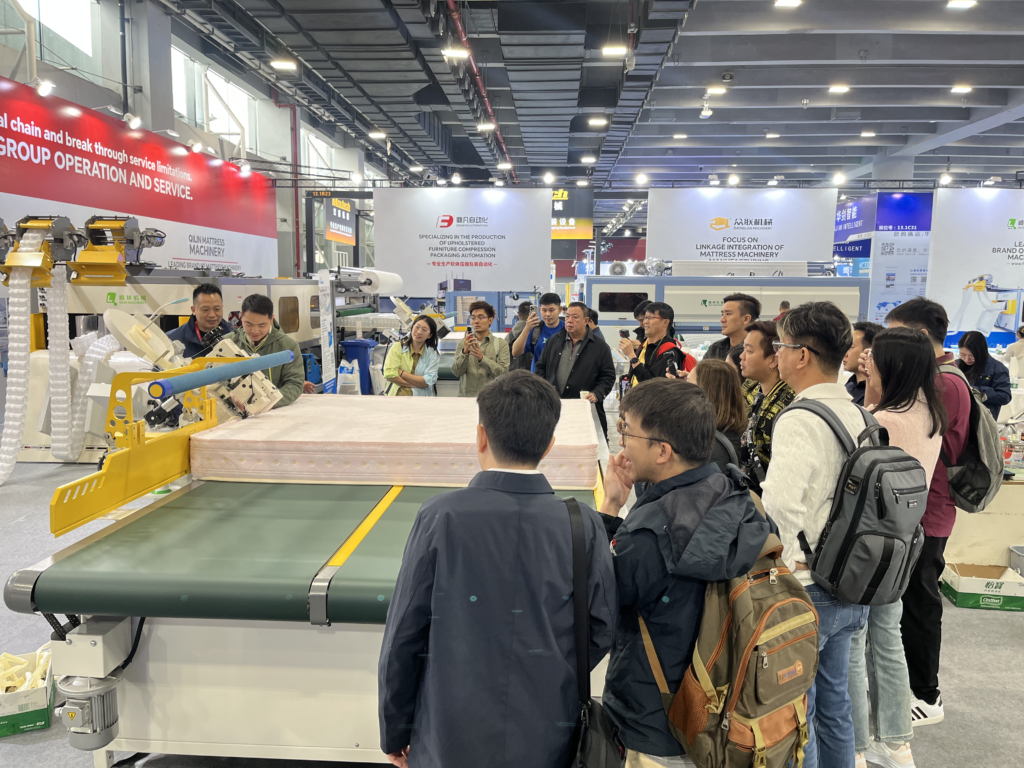
Traditional mattress factories are designed around the assumption that humans will compensate for process instability.
Workers:
- Carry and reposition heavy mattresses
- Judge alignment by eye
- React to machine speed changes
- Correct errors after they occur
While this model can function, it has clear limitations. Human reaction time, fatigue, and variability introduce risk and slow down production. Safety depends on constant attention, which is difficult to maintain over long shifts.
Intelligent production lines remove the need for human compensation by stabilizing the process itself.
Why Intelligent Lines Are Structurally Safer
Safety improvements in intelligent production lines are not achieved through more warning signs or stricter rules. They come from removing people from hazardous situations altogether.
Key safety improvements include:
- Elimination of manual lifting and carrying
- Reduced human-machine interaction zones
- Predictable and controlled machine movement
- Built-in interlocks and motion limits
When people are no longer required to physically handle large, heavy, or moving products, the risk of injury drops dramatically.
Automated Handling Reduces the Highest-Risk Activities
In mattress factories, the most dangerous activities are not sewing or gluing. They are handling-related tasks.
Traditional risks include:
- Back injuries from lifting mattresses
- Hand injuries during alignment
- Collisions during manual transfer
Intelligent production lines use automated conveying, flipping, turning, and stacking systems to handle these tasks. By mechanizing movement, safety becomes a design feature rather than a behavioral requirement.
Predictable Motion Means Fewer Accidents
Traditional production environments are dynamic and unpredictable.
Workers may not know:
- When a product will move
- When a machine will restart
- How fast a process will accelerate
Intelligent production lines operate on predictable logic. Movements occur only when conditions are met, and speeds follow predefined profiles.
Predictability allows:
- Clear safety zoning
- Reliable guarding strategies
- Reduced surprise motion
This predictability significantly lowers accident risk.
Embedded Safety Logic Outperforms Procedural Safety
Traditional safety relies heavily on procedures:
- Follow instructions
- Stay alert
- Avoid dangerous areas
Procedures fail when people are tired, rushed, or under pressure.
Intelligent production lines embed safety into control systems:
- Machines cannot move unless conditions are safe
- Interlocks prevent conflicting actions
- Emergency stops affect entire systems, not isolated machines
This design-based safety is far more reliable than procedural control.
Why Intelligent Lines Are More Efficient by Design
Efficiency gains in intelligent production lines come from removing non-value-adding work, not from forcing machines to run faster.
Traditional inefficiencies include:
- Waiting for manual transfer
- Stopping lines for alignment
- Reworking errors caused by handling
- Overstaffing to cover peak moments
Intelligent lines eliminate these inefficiencies by coordinating processes automatically.
Continuous Flow Replaces Stop-and-Go Production
Traditional production often operates in batches.
Workers wait until enough mattresses accumulate before moving them. Machines stop while products are repositioned. This stop-and-go rhythm wastes time and labor.
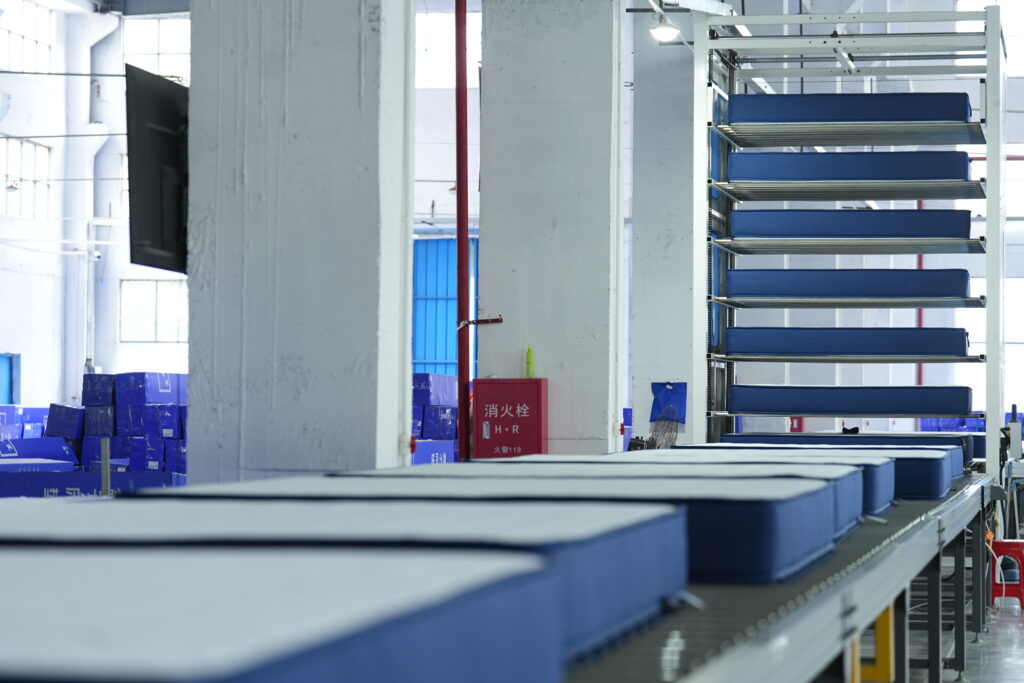
Intelligent production lines are designed for continuous flow:
- Products move automatically between stations
- Timing is synchronized
- Accumulation is controlled through buffers
Continuous flow increases effective output without increasing speed.
Reduced Labor Dependency Improves Both Safety and Efficiency
High labor dependency creates two problems:
- Safety risk from physical strain
- Efficiency loss from variability
Intelligent production lines reduce labor dependency by:
- Automating handling
- Standardizing processes
- Simplifying operator roles
Fewer people are required, and those people work in safer, less physically demanding roles. This improves staffing stability and reduces downtime caused by labor shortages.
Consistent Quality Eliminates Hidden Efficiency Losses
Traditional production often hides inefficiency in quality correction.
Misalignment, uneven bonding, or orientation errors require:
- Inspection
- Rework
- Additional handling
Intelligent production lines improve efficiency by preventing errors rather than correcting them. Automated alignment, measurement, and control systems ensure that products arrive at each station correctly positioned.
This reduces scrap and rework, which directly improves effective efficiency.
Intelligent Lines Support High-Speed Operation Without Increasing Risk
In traditional systems, higher speed means higher risk. Workers have less time to react, and mistakes become more dangerous.
In intelligent production lines:
- Speed is controlled by systems
- Safety zones are clearly defined
- Movement is coordinated
This allows factories to increase output without exposing workers to greater danger.
Better Line Balance Reduces Overstaffing
Traditional lines often require extra workers to handle bottlenecks.
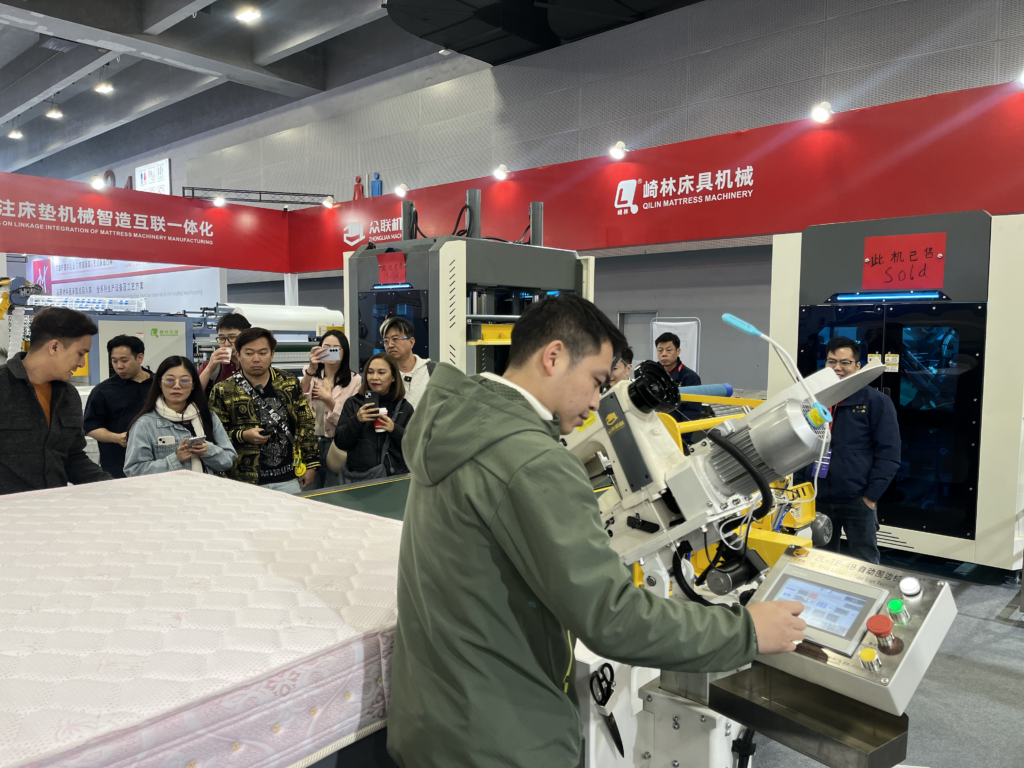
Intelligent production lines use:
- Buffer zones
- Automated accumulation
- Dynamic speed adjustment
This balances flow and reduces the need for standby labor. Fewer workers are needed to produce the same or higher output.
Improved Night Shift Safety and Performance
Night shifts are traditionally associated with higher accident rates and lower efficiency due to fatigue.
Intelligent production lines mitigate this by:
- Reducing manual tasks
- Maintaining consistent system behavior
- Requiring fewer operators
This makes night shifts safer and more productive, enabling 24-hour operation with controlled risk.
Integrated Monitoring Improves Response Without Exposure
Intelligent lines provide real-time monitoring of:
- Machine status
- Production rhythm
- Fault conditions
Operators respond to alarms rather than physically checking machines. This reduces exposure to hazards while improving reaction time.
Safety and Efficiency Reinforce Each Other
In traditional thinking, safety and efficiency compete.
In intelligent production lines, they reinforce each other:
- Fewer manual tasks mean fewer injuries
- Fewer injuries mean less downtime
- Stable processes mean predictable output
This creates a virtuous cycle where safer production is also more efficient.
Summary Table: Intelligent Production Lines vs Traditional Models
Aspect | Traditional Production Model | Intelligent Production Line
Primary control | Human judgment | System logic
Handling method | Manual | Automated
Safety approach | Procedural | Embedded in design
Production rhythm | Stop-and-go | Continuous
Labor dependency | High | Reduced
Injury risk | High in handling zones | Significantly lower
Efficiency stability | Variable | High and predictable
Suitability for 24-hour operation | Limited | Strong
Why Intelligent Lines Reduce Long-Term Operational Risk
Beyond daily safety and efficiency, intelligent production lines reduce long-term business risk.
They:
- Lower dependence on labor markets
- Reduce accident-related costs
- Improve compliance with safety regulations
- Protect brand reputation
These factors become increasingly important as factories scale and face stricter regulatory environments.
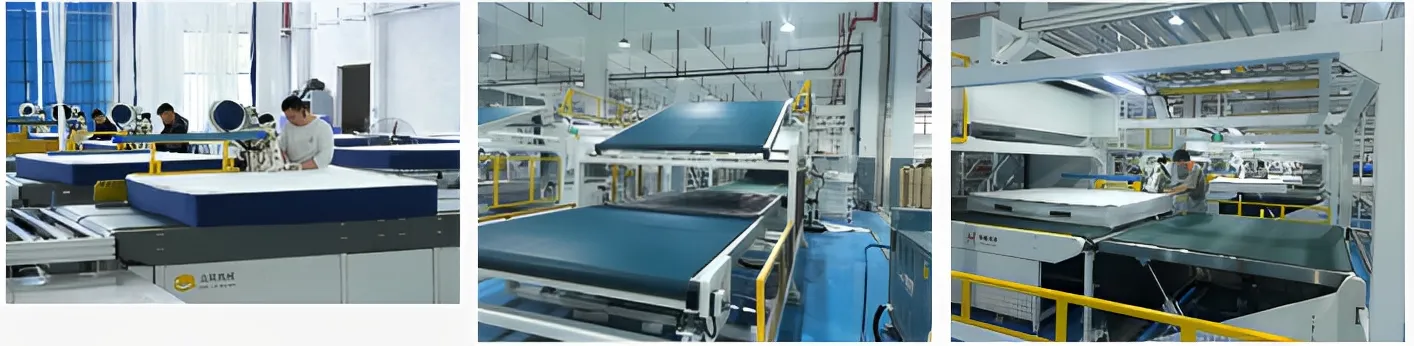
Intelligent Production Is a Structural Upgrade, Not a Tool
Many factories attempt partial automation and expect full benefits. This rarely works.
True safety and efficiency gains come from structural redesign of production logic, not isolated machine upgrades.
Intelligent production lines:
- Redesign material flow
- Redefine worker roles
- Embed safety into the system
This holistic approach is what differentiates intelligent production from traditional automation.
The Role of Integrated Solution Providers
Designing an intelligent production line requires understanding:
- Mattress manufacturing processes
- Equipment interaction
- Safety and control logic
Factories benefit from working with solution providers that deliver integrated systems rather than standalone machines.
More information about integrated production approaches can be found internally at:
https://mattressmachineryzl.com/
Conclusion: Intelligence Eliminates the Safety–Efficiency Trade-Off
Intelligent production lines are safer and more efficient than traditional models because they eliminate the conditions that create risk and waste in the first place.
By removing manual handling, stabilizing processes, embedding safety into control systems, and coordinating production flow, intelligent lines achieve higher output with lower risk.
For mattress manufacturers facing rising labor costs, stricter safety requirements, and increasing competition, intelligent production lines are not a luxury or a future concept. They are the most practical and reliable path to building factories that are both safe for people and efficient for business.
 English
  Vietnamese
  Spanish
  German
  French (France)
  French (Canada)
  Japanese
  German (Austria)
  Tibetan
  Danish
  Malayalam
  Indonesian
  Frisian
  Greek
Greek  Javanese
  Macedonian
  Galician